Don’t Wait for the Diagnosis

I was 38 when I was diagnosed with breast cancer. Obviously, I would never have chosen it—no one would willingly choose it. But with distance and perspective, I find myself feeling something complicated and true: in some ways, I feel lucky it happened to me when I was 38.
I was happy. Married. Raising a family. Working. Achieving.
I was doing many of the things I thought I was supposed to be doing.
Then suddenly I was facing a life-threatening illness, and it interrupted the momentum of my life.
The truth is: Cancer gave me a vantage point I might otherwise have needed decades to acquire.
A New Perspective
Facing a life-threatening diagnosis at such a young age, I found myself doing the kind of reckoning we usually imagine doing much later in life. As I began the fight, I started to wonder…
If my life turns out to be much shorter than I assumed, am I doing what I actually want to be doing?
Is this how I want to spend my time here?
What matters to me? What is meaningful? Who am I?
What do I want to do with the rest of this one wild and precious life?
The Permission Slip
As I pondered these questions and continued my treatment, I realized something profound. My diagnosis became my permission slip.
After years of playing by the rules and doing what’s expected, I now had the “permission” to put myself first. The “permission” to question relationships and choices I might otherwise have continued to accept.
Above all, I now had the “permission” to question some of the assumptions underneath the life I had built. Most importantly, “whose idea of success have I been living?”
How much of what I thought I wanted came from family, culture, the professional world, or expectations of women? How much of my life was I living simply because of the momentum of choices I had already made?
Once these musings took hold, I began paying much more attention to what made my life feel meaningful, purposeful, connected, and genuinely mine.
Living with Agency
I’m sure that, with time, I would have learned many of these things simply by living. But the fact is, breast cancer gave me that perspective at 38.
That’s why I’ve always thought of it—complicated as this is to say—as a gift.
That’s why I’ve always said that if I ever write a book, I’ll call it, “Don’t Wait for the Diagnosis.”
I don’t believe illness happens for a reason, and I don’t believe we should be grateful for suffering. But I do believe we get to decide what we do with the things that happen to us.
Though there have been many years and many turns in between, my diagnosis put me on a path toward reclaiming my own agency. That path eventually led to ALTAR Community and the work I’m doing today.
Over time, the questions I ask myself have become more nuanced:
How do I know what I actually want?
How do I hear myself underneath all the expectations and other voices?
How do I trust my own knowing?
And crucially, how do I stay true to that knowing while being in relationship with partners, family, community, doctors, experts and institutions whose needs, knowledge and perspectives also matter?
The Power of Re/Construction
In recognition of Breast Cancer Awareness Month, I’m proud that we’re able to bring a film and its creators to ALTAR that touch on some of those powerful questions. Re/Construction is a documentary that follows women who have chosen to live flat after having a mastectomy, and the fight for that choice to be respected.
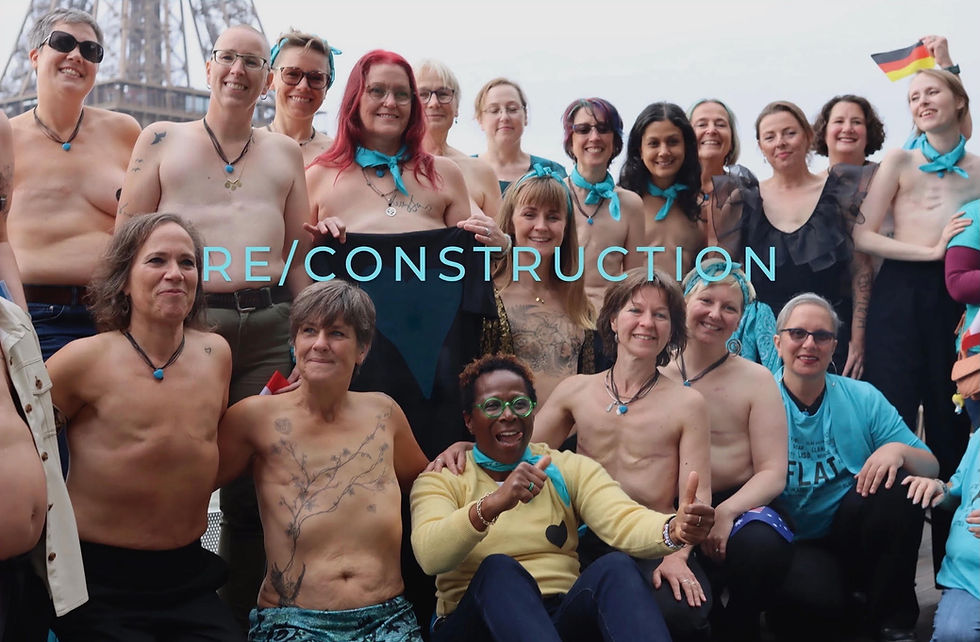
Though undeniably important, this choice isn’t the final point from my perspective. Their right to make it is.
What happens when multiple voices—from medical experts, family, friends, and cultural ideals—point in a different direction from a woman’s own knowing? How do we, as women, remain in relationship with expertise and authority without giving away authority over ourselves?
To me, these questions may arise from a diagnosis. But that doesn’t mean we should all wait for the diagnosis.
So many women wait until the marriage is unbearable, the job is impossible, or our bodies break down before we give ourselves permission to examine what we want. Why isn’t our own knowing enough?
This is why I put the word “permission” in quotes earlier in this blog. We don’t need permission. Our own knowing is enough. But that doesn’t mean tapping into that knowing is easy.
The Way Forward
As girls—and then as women—we absorb powerful ideas about what our bodies should be and equally powerful ideas about what our lives should be. We’re told, in subtle and unsubtle ways, what success means, what we owe other people, how much we should tolerate, and what we are allowed to want.
Somewhere amidst all of that are the questions I keep coming back to:
Who gets to decide what makes a woman’s body whole?
Who gets to decide what makes a woman’s life whole?
Explore These Questions in Community
If you’re interested in exploring these questions, I’d love for you to join us for our screening and conversation on Re/Construction on Wednesday, Oct. 28th.
Together, in partnership with the filmmakers and the American Cancer Society, we’ll have an honest conversation about our bodies, our healthcare, and the importance of respecting women's choices. You can learn more and get your tickets here.


